



Automatic Watches Explained
An automatic watch winds itself. Your wrist turns a rotor, the rotor winds a mainspring, the mainspring runs the watch. No battery. It keeps time less precisely than quartz, and that is normal.
How an automatic movement works
A rotor, a mainspring and an escapement do the whole job.
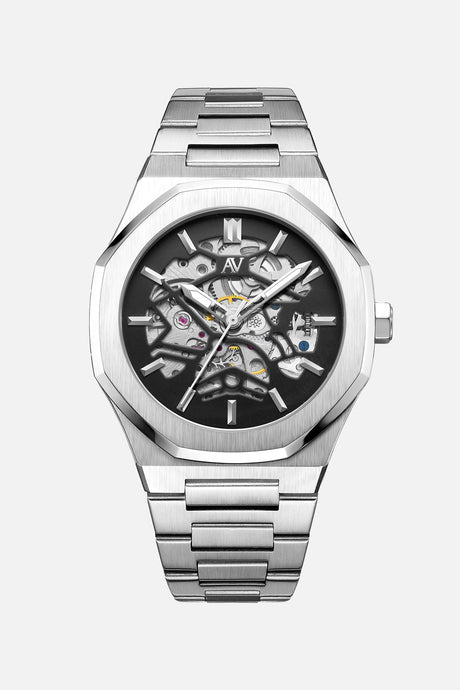
The rotor is a weighted half disc on the back of the movement, hinged in the centre and free to spin. Every time you move your arm, gravity keeps the weight low while the movement turns around it, so the rotor sweeps back and forth.
That motion is geared into the mainspring barrel. The mainspring is a flat coiled ribbon of steel, and winding it stores energy. The barrel releases that energy slowly through the gear train, and an escapement lets it out in tiny, regular steps. Those steps are what you hear as ticking and see as the sweep of the seconds hand.
Nothing else is involved. There is no cell, no circuit and no quartz crystal.
What power reserve means in practice
Power reserve is how long the watch runs after you take it off, once the mainspring is fully wound. It is not battery life and it says nothing about quality.
In our catalogue the Miyota 9015 automatic is stated at a 42 hour power reserve. A watch worn on Friday is still running on Sunday morning and has usually stopped by Sunday evening. Wear it again on Monday and it is running before you have finished getting dressed, though you will have to set it.
A watch you wear most days never stops. A watch you wear twice a month always will. Neither is a fault.
How automatic and quartz differ
Quartz is more accurate and runs on a battery. An automatic needs no battery and stops once you stop wearing it.
| Point | Quartz | Automatic |
|---|---|---|
| Power source | Battery, plus a quartz crystal oscillator | Mainspring wound by the motion of your wrist |
| Accuracy | Higher. Quartz is the more precise technology | Lower. Deviation is expected and is not a defect |
| Maintenance | Battery change every few years, with a new case gasket each time | No battery. Winding and wearing, and setting it again after it stops |
| Behaviour when unworn | Keeps running | Stops once the power reserve runs out |
| Seconds hand | Steps once per second | Sweeps |
| Suits | Occasional wear, travel, anyone who wants to pick it up and go | Daily wear, anyone who wants a mechanical watch on the wrist |
| Battery disposal | Contains a button cell, which must not go in household waste | Contains no cell at all |
Which movements we use
Six movement families run in the catalogue, and two of them are automatic.
- Miyota 9015 automatic, with a 42 hour power reserve, on ten watches.
- Seiko self-winding automatic mechanical, on three watches.
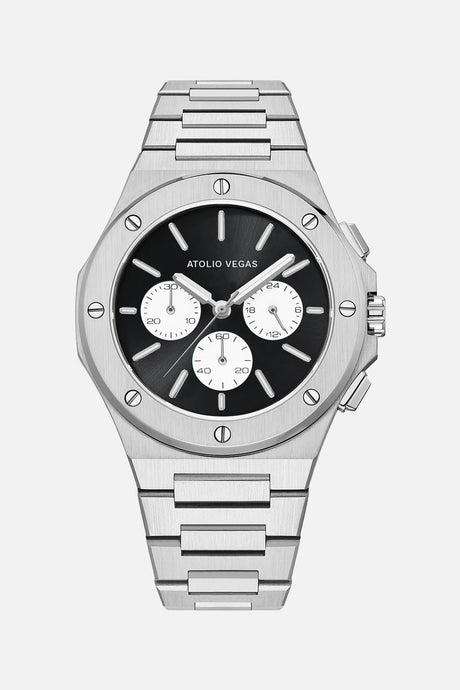
- Japanese Citizen Miyota quartz on twenty watches, and Japanese Citizen Miyota chrono quartz on eight, where the chronograph sub dials are fully functional.
- Swiss Ronda quartz on twelve watches, and high precision Japanese quartz on three.
The 42 hour figure belongs to the Miyota 9015 and to no other movement in the range. Where a power reserve is not stated on the product page, we do not state one here.
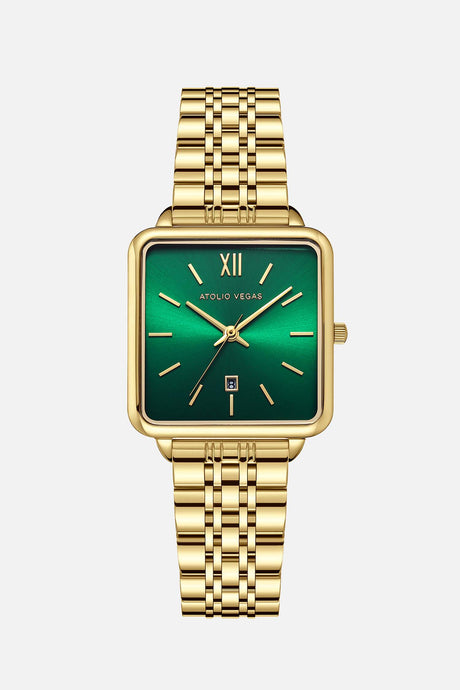
If the automatic is what you want, it sits in Valor Automatic and Zolten Automatic. The Valor Automatic in black and the Zolten Automatic in silver both run the Miyota 9015 in a 316L stainless steel case at 42 mm, water resistant to 10 ATM, on an interchangeable steel bracelet with a butterfly clasp.
An automatic is less accurate than quartz
That is physics rather than marketing. A quartz crystal vibrates at a fixed high frequency and a circuit counts the vibrations. A mechanical escapement is a spring and a lever, affected by temperature, by position and by how far the mainspring has unwound.
So an automatic gains or loses time every day, in a way you can notice over a week. That is normal for the technology and it is not a warranty matter. A movement that stops under normal use is, and we treat it as a manufacturing defect.
You do not buy an automatic to be told the time more precisely. Your phone does that. You buy it because a machine on your wrist runs on nothing but your own movement.
Should you buy automatic or quartz
Automatic if you wear one watch most days. Quartz if you own several and rotate them.
Buy an automatic if you like the idea of owning something mechanical and if setting the time after a weekend off does not annoy you.
Buy quartz if you travel across time zones often, or if you want to open a drawer after a month and find the watch right. Thin cases, chronograph sub dials and the highest accuracy all sit on the quartz side of the range, in men's watches and women's watches.
How to wind and care for an automatic
An automatic that has stopped needs a starting charge before the rotor can take over. Wind it gently by hand at the crown until it runs, then set the time and put it on. A normal day of wear keeps it wound from there.
- Never operate the crown under water, and check it is fully closed before the watch goes anywhere near a tap.
- Keep the watch away from perfume, cosmetics and cleaning products. Damage from those is not covered by the warranty.
- Wipe the case and bracelet with a soft dry cloth after wear, and store the watch in its pouch.
- Do not force the crown or the hands backwards through a date change if the watch resists.
- Remove the small sticker on the crown gently with a soft cloth. It is only a protective film from assembly.
Watches carry a 24 month warranty on parts and workmanship under normal use, and statutory rights apply independently of it. The FAQ page covers claims, returns and delivery.

